Introduction

Introduction

While I was born in 1951, sometimes I feel like I was born in 1914. My father told me so many stories about growing up in Philadelphia, and occasionally even about his family, that I feel some sense of at least one person's life in those years before I was born. While my mother, of course, wanted a child, I'm not sure that my father did. I think there was a part of it all that scared him, so they waited quite a while to have me. I hope I was "a relief" to my father, and I think I worked hard to be a good son. Looking back, especially at those few older pictures I have of my father, I think the very best part of his life was the first half - back when things were simple, he had good friends, and the burdens of adulthood were not yet upon him. Looking back, I feel like the best part of my life was the first half, largely due to my parents. It was a time when life was simple, controllable, and when I was actually organized! I'm sure my father found many good things in his entire life, as do I, but I believe we had this in common - that there is nothing better than growing up in Philadelphia. So, do not find the title of my new blog in any way depressing, my friends, its just a perspective that I've found interesting to investigate.

I'll start by writing about my family. I realize we are nothing special, but as we've learned from millions of pages of memoirs written and published, there can be much to be learned from those who came before us.

As I get past some family stories, this blog may be of interest to anyone who grew up in the Delaware Valley/Philadelphia/Delaware County in the 1950's and 60's, or to anyone married/partnered to one (if you are, there is much you need to understand before the two of you can communicate!).

Please check out my book, Saturday Night at Sarah Joy's. All proceeds go to the Hurricane Sandy NJ Relief Fund. Information is available at: saturdaynightatsarahjoys.blogspot.com.

Thank you!


Wednesday, August 15, 2012

Under Two Flags


            My father served in the Army Air Force during World War II.  He began his military service in 1943.  He was 30 years old when he entered into active duty.  I can't imagine - 30.  He had less than a high school education.  They invested in him, training him to be an aircraft mechanic.  During his service, he traveled around the country, from New Jersey to Florida to Texas to California, and while Japan unconditionally surrendered on his birthday, August 14, 1945, before he could be sent overseas, he had been prepared to go to War.  He made real friends in the service.  He was respected in the Air Force, and was quickly promoted to the rank of Sargeant.  Of this he was proud.  They taught him discipline and responsibility.  Also, he was well cared for and entertained.  At USO shows, he saw all of his favorite movie stars - Judy Garland, Bob Hope, Jack Benny, and his absolute favorite, Al Jolsen. (White singers who perform in black face probably wouldn't sell today, but you had to be there.  It was all about the music.)  This is not the life he would have lived on his own. 
His service had an impact on my mother as well, who probably never would have left her family in Philadelphia were it not for an opportunity to spend a few months with her new husband in Florida.
 The Air Force changed their lives.  The experiences gave them perspectives they would not otherwise have had.  One thing their Air Force duty did for me was to document their love affair.  The cedar chest in the back bedroom had a collection of annotated photos they'd sent to each other, letters, post-cards, and my favorite - records that my father made and sent to my mother on which he sings her love songs and tells her how much he's thinking about her.  They're both gone now, but I can still hear a love-struck guy singing to his girl whenever I want - feelings burned into red vinyl.
            I didn't think that my father understood if he was actually a Veteran.  After all, he had not seen combat as many friends and family had.  Dad never went to a VFW hall, and never seemed to relate to Veterans.  He had done nothing special, just served two and a half years in the job of his life, and he was more indebted to the Army than he expected the Army to be to him.
            I was born into a good family who took good care of me.  I was 7 years old in 1958 and  WWII was still fresh in people's minds.  Many of my parents' friends served during the war, and had souvenirs tucked away in their underwear drawers - a hat, a medal, a German coin, a bullet shell.  I collected many of their memories - cherished items that I'll have until I die.  Their feelings were reflected in these proud mementos.

            As we grow, the problems that we stew over change.  When I was young, I played until I cried, not understanding why aching legs and feet wouldn't let me run all through those long summer days and warm summer nights with my little friends.  Fortunately, my parents took me to a doctor who determined that I had flat feet.  For the rest of my young life, I wore orthopedic shoes from Shapiro's in Philadelphia, the company that also made shoes for many of the Phillies and Eagles.  Thankfully they modified normal shoes, such as Hush Puppies, so only I knew that I had a specially made insert to deal with my malady.  Orthopedic - it sounded so . . . lame.  As I became a teenager, I found myself asking those seated around me in school what the assignment was on the board.  I borrowed someone's glasses and realized what I had been missing.  Another glaring defect!  When you first put glasses on, the world stares and laughs, of course.  The girls in 7th grade used to steal my briefcase (yes, my briefcase) and extract my glasses to pass around.  It was a major point of embarrassment. 
            Then an awareness of issues larger than corrective lenses changed the vision of everyone.  The cold war.  Nuclear capability.  As I was dealing with the humiliation of spectacles in 1962, I was also reading booklets I'd requested by mail such as Handbook H-7, Family Shelter Designs from the Office of Civil Defense/Department of Defense.  I particularly liked design PSD F-61-1, a lean-to fallout shelter with a whopping 128 cubic feet of space, to house three people, and food.  Consider this - a room in which a 6 foot man could stand and sleep, a room 6' x 6' x 6', contains 216 cubic feet.  This structure was little more than half of that - and was supposed to be a shelter from a nuclear storm.  This was before the phrase 'nuclear winter' was even imagined.  Another Civil Defense pamphlet, Fallout Protection, calmly defined terms such as megaton and explained 2000 mph blast waves.  It is clear today that not even JFK's secretary of defense Robert McNamara had a clue, acting like, after a nuclear weapon is detonated, nuclear fallout would be over in a few days, when we would then sweep up and retaliate.  I, the little adult, worked with my parents to almost convert part of our basement to a fallout shelter.
            The Cold War was such a sweet war - a battle of good and evil - and we were good.  We were pure.  Then, Southeast Asia took over the too-small black-and-white cathode ray tubes of our TV sets.  The government invented a new vocabulary, and we were expected to call it a military action.  We did not.  It was The War.  Symbols like the Berlin Wall rapidly became replaced by Kent State and Jackson.  Civil unrest and civil disobedience percolated up into mainstream life, even in the city of Brotherly Love.  Our founding fathers would have expected nothing less. 
            I quickly grew, like my peers, to hate The War, hate the government that kept us in it, and it is unfortunate that we also came to hate those who fought.  They were sellouts.  It was not unusual to see a bunch of long-haired Vietnam vets smoking a joint in front of the VFW hall.  Older Veterans wanted nothing to do with them.  Veterans were no longer older, distinguished gentlemen, but late-blooming hippie losers.  Perhaps that's why we couldn't even call them Veterans.  They only deserved 'vet', lower case v.  There were no parades, no celebrations when they returned, only a bitter, traumatized country.
            Pat C. was a childhood friend, the son of an army lifer.  Pat was never anywhere for more than a year or two, constantly moving as his father was reassigned, but there were at least two periods that his family spent in the Philadelphia area, and these times were when we became friends.  The letter from Pat in California that I kept was typical, decorated on the outside with "Peace in Vietnam - through VICTORY!".  It's actually taken me decades to piece together its place in our history.  The letter was dated June 20, no year.  In it Pat goes on for two pages about a Dodgers game he attended where Don Drysdale set a record and (of course) beat the Phillies in the process.  Drysdale retired in 1969, so Pat must have been at the game on June 8, 1968 when Don pitched 4 scoreless innings against the Phillies to break the major league record of 56 scoreless innings, set by Walter Johnson in 1913.  The Dodgers beat the Phillies 5-3.  A few days before, June 4, Don pitched a shutout.  It was the day of the California Presidential Primary.  Robert Kennedy, who won that election, congratulated Don late that night as he spoke to those who had worked so hard for him.  Shortly after midnight RFK was shot by Sirhan Sirhan.  The world was going mad.  I had no idea how many wars were actually in progress.  Only two months had passed since news of Dr. Martin Luther King's death came out of Memphis.  Reverend King was only 39 years old.  Pat was discussing baseball.  RFK had just been taken from us, not far from my friend Pat, and I was reading a letter about a baseball game.  He had become my military-industrial complex.  I never wrote to him again.  What was happening?
            A year later, 1969, I graduated from high school and went to college with a 1-S student deferment from the draft board nestled in the corner of my wallet - my draft card.  I hated the war.  I protested, wrote letters, and grew hair.  Through it all my parents tolerated me, supported me, and, I believe trusted my judgment.  It taxed their trust in their country, but then the children dying on the TV every day were my age.  It was the most real War we had ever encountered, or so I'm told.  In December 1969, when I was in my first year of college, the draft as we knew it ended.  The Lottery was created.  On the same TV where I watched Philadelphia local Chief Halftown's Cartoon Hour, where we watched children die, we now watched birthdates selected, to determine the order in which we would die.  If your birthday was selected first, #1, then you would be the first to be drafted for that calendar year.  If your birthday was #365, they probably wouldn't get to you before the year was over and you would have dodged a bullet.  The 1-S deferment became good only for the academic year in which you were currently enrolled at college.  In that first draft, my lottery number was 127, although I still had that fragile deferment.  That year they drafted up to 196, so I would have been called.  In 1972, they drew the lottery for 1973.  My birthday was drawn as #11.  In 1973 I was graduating from college, losing all protection.  I was going to be drafted.  Eleven.  I spent that day decorating a t-shirt with a big red, white and blue 11 on it.  It hung on my chest like a bullseye, or it would have if I ever put it on.  I couldn't.  I couldn't let it become me.
            I sprang into action, much more so than my friends, and to this day I don't know why.  Yes I do.  They were all greater than 11.  I talked most with my parents about my feelings, although at that time no one talked about their feelings.  I returned on the #11 trolley (!) from my trip to the Philadelphia ACLU office with lots of pamphlets and books and ideas.  I decided that I was not willing to serve - not in any capacity.  I didn't want to be a vet or a Veteran and I didn't want to be a dead son.  I didn't want to shoot a human being.  I didn't want to participate in this war.
            I read books and studied deferments.  I considered pursuing a 1-O classification, declaring myself as a conscientious objector, which I in fact was, but thousands of young men became Quakers that year to express their objection to violence of any type.  The Army was unwilling to recognize such short-lived expressions of a life dedicated to peace as anything other than a move to avoid the draft - which it was.  Besides, a classification for documented conscientious objectors still required that you work at a job approved by the draft board for two years.  I needed something else.  We were supposed to be Free Birds  - Lynyrd Skynyrd said so.
            My deferment research, studies of a rapidly moving target, suggested that I had some chances, albeit small ones.  Shapiro's wrote a letter about my long problem of flat footedness, implying that they wouldn't hold up to marching and having to stay on my feet.  They'd treated me for years, so I had 

established the problem extensively.  Still, the odds were high that I'd be put into some non-combat position if I had foot problems.  I also got a letter from my sympathetic optometrist, Dr. Cohen, lamenting the problems that would arise should I lose my glasses.  Focusing as best I could for a nearsighted teenager, I looked to Canada.  Canada is where you went to disappear.  It was our understanding that, as deserters, we would be arrested if we ever tried to return from what was presumably a great wilderness where people lived in tents and cabins.  My parents knew I was giving it thought, but not seeing them again just wasn't an option.
            Orthopedic shoes and glasses - these are what I'd be gambling on to get a deferment?  More severe than the discomfort of flat feet was a real deformity.  I needed a deformity to avoid the draft, it appeared.  It seemed to be incredibly simple.  Chop off one toe and it was over.  Even if I messed it up and walked with a cane for the rest of my life, it seemed like an exceedingly small price to pay.  "Toe" moved to the top of my list.  "Chop off toe."  Not extract or remove - chop.  Drama queen.  Need:  hatchet, rags, Bactine (?), friend?  No.  No friend.  This was too messy, too personally and physically messy, to ask someone to participate. 
            The deferment due to psychological problems became a popular option but unfortunately disappeared too fast.   The good news was that unstable people were becoming a draft problem.  In the second half of 1968 at Fort Dix NJ and nearby McGuire AFB there were 96 attempted suicides among 37,000 trainees.  Presumably some were very late attempts at medical deferments.  Nine of the suicide attempts were successful - also nine successful attempts at securing deferments after being drafted.  All had been declared fit for duty in their physical examinations, so emotional stability became a real issue.  Suicides were bad press for the government.  In these times we would not hesitate to become Mash's Klinger if it meant staying alive. 
            The story goes: A guy calls his friends and says, "I won't go to Vietnam, I'd rather kill myself.  I'm going to throw myself off of the bridge."  Then he walks up the Walt Whitman Bridge, or gets dropped off, and patiently waits at the top while his concerned friends call the police who respond and talk him down.  A few visits to the psychologist and he's declared cured for now, but he has a record of psychoneuroses so he gets a medical deferment.  Within a few days, the story gets out and the Walt Whitman Bridge is lined with jumpers.  That's when the police decided that the long line of stinking hippy commies were free to jump away if they'd like.  Unfortunately, Walt Whitman, Ben Franklin and Betsy Ross were not going to be the roads out of this dilemma in Philadelphia.
            Still, as a teenager, I had come to hate what this country stood for and what it was doing to itself and the world.  If nothing else, we thought about the issues a lot.  I learned some things.  I decided that I wasn't going to feel bad about burning a flag because a flag was really just cloth and people shouldn't confuse cloth with freedom and what was good from our past.  The flag was one issue I never had any luck explaining to my father - it was a sacred thing to him, more than cloth.  My green and white ecology flag, a clear variation of the real thing, was never welcome in our home.
            The passing time was now a ticking bomb.  Bitterness consumed those around me.  The government, the flag, the army, the draft - we have to tear it all down.  It's money, it's hate, it's death, it all became too real, too big - Godzilla looming over our national skyline.  Day after day, we sat through the televising of a war - people I knew, or should have known, were napalming the crap out of an entire country.  It was insane.  I had to do something.  Now it was personal.  I wasn't going to participate.  The doctor's letters were in a manila folder in my bedroom.  I had maps to Canada.  I had names of Canadian employment agencies.  I had rags to stop the flow of blood.  Too many questions.  What do you do when you hit bone and the joint doesn't come apart?  I had lists of things you could eat that would throw off urine analyses and suggest diseases - early excursions into applied chemistry.
            Early 1973 (two years after Nixon lied to us and announced "the end is in sight") - Nixon, Kissinger, Nguyen Van Thieu, Le Duc Tho - they talked, they stopped talking, they wrote letters, negotiations stopped, they restarted.  On January 23, 1973, President Nixon announced that an agreement had been reached to 'end the war with peace and honor'.  We didn't even pretend to be listening to the end of that sentence.  Four days later the Paris Peace Accords were signed.  On that same day, January 27, 1973, William Nolde died, cited by some as the last American soldier to die in combat in Vietnam.  Had I been a praying person I would have prayed for William's family, and I hope he is never forgotten.  Also on January 27, Secretary of Defense Melvin Laird announced the end of the draft.  The relief was incredible but the trauma of a nation did not subside overnight.  Forth of July parades continued to crackle and clang through the decade as Veterans continued to pass away and burnout vets began to show signs of aging.  In 1974, President Ford announced a clemency program for draft dodgers and deserters.  More than 22,000 took him up on his offer.  Another eligible 100,000 did not.
            The United States slowly found a new national optimism and, with it, a new national guilt over turning our backs on our own.  In November 1982, we formally welcomed Vietnam Vets home with a memorial - a bleak, black granite slab containing the names of over 58,000 women and men.  Never was the conversion, the correction of lower case to upper case, so emotional.
            The 60's had passed, the 70's and 80's slid by, and for the first time I saw my father confused about some thing that was very simple.  Too few years later he was in a nursing home with Alzheimer's disease or dementia or something not needing further definition.  Frequently he didn't know who I was, but he liked to sing.  Sometimes it would be a song he'd sung as a child, growing up with Italian neighbors in South Philadelphia, like O Solo Mia.  Sometimes it was Oh, Dem Golden Slippers, a minstrel song that dominates the Philadelphia's Mummer's Parade.  Sometimes it was a delayed replay of an event.  He'd remember seeing Al Jolsen live 50 years ago and he'd start to sing Mammy.  It was a recreation - Al Jolsen live at the Rose Bowl entertaining the troops.  Al was telling me how substantial the experience of military service was in my father's life.  With the consuming threat of going to war tucked into his hat, with a photo of my mother, there were many days of heaven for him in the Army.  He had had the proverbial time of his life.  In his last days, his memories served him well when I could not.
            It was a cool October day in 2000 when we buried him.  I was there to stand at my mother's side, there to serve, there to take care of it all.  Personally, I dislike the mindless and dated pageantry of funerals (perhaps as I've disliked many things in the past that were too big to change) but I went through this one for the family. Short service, carry the casket to the hearse, drive out to the cemetery, seated, ready for a few final words  -  and then I could pronounce it as over.
            I felt like I had been physically hit by something when I looked up and saw the casket.  I had no idea this was going to happen. The American flag draped over the coffin snapped in the cold fall wind.  It was not the flag that I had dismissed, not that flag that I had chosen to declare as irrelevant.  It was the flag of his country, and it had wrapped itself around him, protecting and repaying him, thanking him.  There were two Veterans there, two older gentlemen, volunteers, in uniform - a volunteer honor guard.  They had materialized into our drama from nowhere.  They had never met my father, but they stood at attention through the pastor's comments, then folded the flag, then presented it to my mother and thanked her on behalf of the country for my father's service.  I never got the chance to tell them what it meant.  I never got the chance to find out who they were.  Why were they doing this?  Did any of them wear orthopedic shoes?
            Clearly, in the war du jour, Americans are learning how to recite the mantra of hating the war but supporting the warriors, because we now appreciate, or have relearned, that service women and men face difficult situations and discipline demands their preparedness to follow orders.  I think I always knew that Veterans were all heroes who sacrificed for us.  Why else would I have worked so hard but to avoid the sacrifice?  Our arrogance made us too quick to anger in a time when it was easy to ask "how could you?" to a Vietnam vet, when you yourself had not been faced with that instant when you would have had to say - "I will not go, I will not serve, I will humiliate my family, that just doesn't understand, for myself."  Self-centeredness has certainly become the key characteristic of baby boomers, I'm told.                       
            In that cedar chest in the back room there is a long rolled up photograph that must show a hundred men in front of a hanger.  They're not in dress uniform, but dressed to work - dressed in Army coveralls.  Many of them are standing at attention, tall and proud.  When I look into their eyes, I see that many of them were not high school graduates, some had flat feet, many wore glasses, and many of them had spent a month's salary to sit in a recording booth for three minutes to sing to their girl.  I have a feeling that those hundred faces represented more than one night of tears at the thought of shipping out and lying wounded and dying in a rain-filled ditch with only a photo and perhaps a baseball card in their helmet to link them back to this life.  In the back row of the photo, there are two goofballs with smiles and their arms around each other.  They are not defiant smiles; they are not smiling even though they had been ordered to stand tall.  They are smiles of simple happiness.  One smile is on the face of my young father.  He made friends easily and took friendships seriously.  Service during the war was a very good thing for him.  Sometimes when I'd walk into his nursing home room he'd be far away, but he'd be sitting up straight with his head held high.  I've decided that, at these times, he was in his uniform, standing tall and proud, under a flag simpler than mine, understanding it all.

© 2006 John Allison
This was published in The College of New Jersey Review, April 2006

My Town

I grew up in a small town, and probably like everyone else, I always think it was a one-of-a-kind place.  Honestly, I don't think I've seen another place like it.  There weren't a lot of houses, but they were all good looking, and many of them looked the same.  My friend lived in a two story, and used to act like he was richer than those of us who lived in ranch houses, but at least our front door worked!  There were a dozen street lights and we actually had one outside of our house.  It was sweet.  Down the end of our street was the church, the one church, and down the other end of the street there was the diner.  We also had a pretty nice gas station, for those who didn't use the public transportation. We were small, but we were big enough to have a fire house.  That was interesting too.  We were probably the luckiest town around because we never had a fire, none that I remember. It probably sounds like our town was just one street, and it almost was; Main Street was one big circle with a small lake, Mirror Lake, in the middle.  Oh, would we skate in the winter!  We'd often sit on the back porch or just stand in the back yard, and watch the train go by.  On some days the train would go by, oh, about 50-60 times a day.  You knew it was going to be a good day.  Some times there would be lots of freight trains, other times lots of passenger trains, and then there would be days when nothing but a trolley car would zip by on the tracks.  We'd watch the train round the curve and disappear into the tunnel.  I always liked the freight train because sometimes you could see the smoke coming out of the engine as it choo-chooed along.  The train station was a busy place, that's for sure.  We also had a loading area where the freight train would stop and they would load and unload stuff - never knew what it was.

Probably one of the unique parts of our town was the tree.  We had normal trees, of course, and shrubs, lots of shrubs, but we had this tree.  If you compared it to our ranch house, I estimate it was about 13,000 times as high.  Sometimes it was just hard to sleep at night, especially when the lights on it were blinkers.  I used to have to cover my bedroom window with cardboard.  The tree made the whole town smell great, but like any thing in nature, it was dangerous as well.  One time, when I was walking to school, which was held in the church, a pine needle slightly longer than I was tall fell and knocked me to the ground.  My mother said she hoped that someday we'd have a hospital, but hadn't yet seen one in the catalog, whatever that meant.

For a small town, let's just say I've seen my share of catastrophes.  I've seen trains derail, trains run into cows, cars, ice skaters, and once, even the diner.  I was actually sitting in my back yard that incredible night when a passenger train was slowly rolling by.  You could see the passengers through the windows as the cars rocked back and forth.  I caught it from the corner of my eye, falling from the tree - tinsel.  We'd had tinsel fall in the back yard before, and once even on the roof, but this time I saw it fall, and fall, and land across the train tracks.  Sparks flew everywhere, big sparks.  It was like lightning coming up off of those three tracks.  Before the train could get to the tinsel across the track, everything went dark, even our street lights.  We just sat tight until power came back on.  Even now, so many years later, I haven't been Plasticville for years, but I still keep an eye out for falling tinsel.  I'm sure some of you know just what I mean.  It was a long time ago (before we went HO).


© 2012 John Allison

My Shooting Star (a monologue)


She was a woman well into her 70's.  I was 13.  I saw her once a week, and paid her two dollars.  In the summer she probably missed me, because she paid me.  I can't tell you how much time I spent under her, blowing bubbles. 

I should elaborate.

The brass plaque on her front porch proclaimed: Gladys K. Norman, Teacher of Piano.  I was about 12 when I told my mother I wanted a piano, and let her empty my savings account.  It was a good down-payment for a nice little spinet.  We contacted Miss Norman, who lived almost two blocks away, and she had to first visit us, so, like a doctor, she could inspect my instrument in the presence of my parents (since I was a minor).  Miss Norman was among the first women to get a degree from Penn, and taught not music theory but traditional piano as a performance art.  When we met, she was legally blind.  Her makeup reminded me of my grandmother, at her funeral. Every Tuesday night from 7th through 12th grade, I'd carry my crescendos and ritardandos to her house at 6:30 PM.  I'd sit (quietly!) on her sofa, making the victim before me even more nervous.  She really could barely see; she'd have to press our money to her glasses to see the denominations.  But somehow, she'd know when your half-hour was up, making a note in her book with her favorite, leaky fountain pen.

Her home was a fascinating place on occasion.  I remember the first time she turned into a fucking nut case.  Prim and proper Ms. Norman was sitting in her stuffed chair beside the baby grand listening to me crank through The Moonlight Sonata, and a voice came out of the kitchen.  Apparently she lived with her mother, who had the assignment of laying quietly in the kitchen on a sofa, while Ms. Norman was working.  Maybe she was duct taped to the sofa, I never really knew.  This one night a weak voice squeaked out of the kitchen, "Gladys?"  It waivered like a note from a piano wouldn't.  Gladys popped up so fast, the doilies flew from her chair as she bolted out to the kitchen, heels clicking on the linoleum, to scream at her mother.  "You know I'm working and I can't be disturbed!"  Jesus!  Her button had been pushed.  Once I even incorporated it into my music.  I hadn't practiced.  The week flew by.  There I sat, ready to disappoint.  I had just started playing Edvard Grieg's Norwegian Dance when that voice floated into the living room and, as my teacher was doing her "shut up mother" rant, I smoothly transitioned from the top of page one to the bottom of page two, which she heard as she returned.  "Good job," she said.  I couldn't believe I got away with it!  Then, without missing a beat (music joke), she smiled and said "Let me hear it again."  Too funny. 

Every evening in the summer Miss Norman would walk past my house to the Collingdale swim club - an old woman on an old mission.  She'd ease out of the dressing room, a blind woman without her glasses.  Her bathing suit was so old it probably had T-rex's on it.  She'd ease into the pool, and would swim a few laps (with Neptune as my witness) at a speed no one had seen before.  To document a single stroke, you wouldn't need a photographer, a painter would do.  She would swim in a straight line, through and over people.  Very slowly a hand would hit your head, then an elbow, then a shoulder, then you'd know what would come next so you'd move for the woman who was crawling over you.  While she was my teacher, to my young friends she was entertainment.  For some reason, as she was doing her laps, we would swim under her and blow bubbles.  What can you expect from thirteen year olds?

In the summer, she'd hire me to cut her grass and keep her gardens weeded and bushes trimmed.  She didn't pay me by the job, but by the hour.  It sounded reasonable.  Every time I started working she'd start playing the piano.  It was never a waltz.  I don't know where she found this hell music, but I swear  - the piano creaked under the stress.  Strings hummed in unnatural ways.  The faster she'd play, the faster I'd work. I cut the grass and weeded and raked, and I got a quarter?  Why?  Because I'd only worked for 15 minutes.  I never earned any money that folded.  Funny girl.

Perhaps what I miss most of all is that, when I mastered a piece, whether it was one of my first, with the notes written on an index card, or the seven exhausting pages of Rachmaninoff's Bells of Moscow, whether I was 13 or 17, mastery was rewarded with a gold star.  (Some of you will remember from school the gold and silver stars, always kept in a little box in the teacher's desk.)  Since she was always a proper woman, she always wore a dress, always wore makeup, and always had her bright red hooker nailpolish on.  Sometimes when she put a star on my music, the fountain pen ink on her finger would get licked along with the star, and the star would have a blue tail.  My little shooting star.  Sometimes it would have a red tail, if the nailpolish was just right - stars with tails like comets.  Each one was an original objet d'art to me, and she never could see what she had created.

She taught because she loved to, and at the time, all I could do in response was to supply an occasional set of bubbles.  I hope they felt good.  She deserved that.


© 2012 John Allison

Heroes in the Dirt, and other folk songs (a monologue)

Dick Allen, who played for the Philadelphia Phillies, was a hero of mine, and I'd like to tell you why.  When I was young, I usually fell asleep on the living room floor when my father turned on baseball games.  Still, I loved the actors of the game, and spent every penny I made, shoveling snow and cutting grass, on baseball cards.  Dick Allen had all the characteristics to be a hero for me.  He had guts, was talented, creative, and was always in trouble. 

They called him Rich or Richie Allen, since he preferred Dick. Allen was a star hitter for the Phillies in the 1960's.  He was disliked because he was the first black player on the modern Phillies team.  They were always looking for a reason to hate him.  Early in his career he got in a "fight" with another player who hit Dick with a bat.  That player was fired, and Allen was held responsible by the fans because a white player lost his job.  They were looking for a reason to boo, and always found one.  He grew a moustache; he was told to cut it off.  He was always being harassed.  But for 6 days in 1967, he did something amazing, something no one's had done before or since.  He wrote in the dirt.

Dick Allen led the American League in home runs twice.  His career batting average was .534, which no one has today.  This guy used one of the heaviest bats made, and hit home run balls 500 feet!  Pre steroids!  The joke in Philadelphia was that Phillies fans booed Allen all the time, because when he hit a home run, there was never a souvenir.  His fielding wasn't as good as his hitting, so they moved him around a lot. Still, by the end of his career, he had been compared to Mickey Mantle, Willie Mays, and Babe Ruth.  Philadelphia was the last city to integrate black players into their team, so the treatment of Dick Allen was a sad time in the City of Brotherly Love.

Dick Allen was black.  Dick Allen was disliked.  For some reason, we could all love Aretha Franklin and the Four Tops, but we couldn't let him in.  Horrible signs were hung from the railings of Connie Mac Stadium.  They threw things at him when he took the field - ice, trash, flashlight batteries! - so he had to always wear his batting helmet. 

One day in 1967 fans were booing him because he hadn't hit a home run lately (and because he was still black), so he wrote in the dirt, in big letters, between second and third base, C-O-K-E, because he intended to hit a home run over the Coca-Cola sign in the outfield.  The next night he wrote B-O-O.  They did.  


The Commissioner of Baseball was there and didn't like Allen having his own personal blackboard, and between games of the double header, he told him so.  In the second game, Allen wrote N-O.  Later he wrote W-H-Y.  This was an amazing thing to watch.  Theatre in the middle of a baseball game!  A single man, standing in the middle of thousands who disliked him, finding a voice as loud as theirs. 

A process had quickly evolved.  Allen would write something in the dirt, which would stay there until the end of the inning.  Then the grounds crew was sent out to erase his words.  On his last night of writing, the plate umpire was asked to tell him that the owners wanted it stopped.  That was when everything changed, just a little bit.  He wrote M-O-M.  World's shortest monologue.  Corny?  Not when emotions were running so high!  The fans had to decide between the front office, who was willing to erase the word MOM, and the man who wrote it.  They sided with Dick, and feelings slowly started to change.  Unfortunately, by that time Dick Allen was tired of the constant fighting and it just wasn't fun to play baseball anymore.  That was too bad.  That night, after the inning was over, the grounds staff refused to erase the word MOM, so it remained there for the rest of the game. 

While I slept through most of the Phillies games on TV as a kid, my father did help me to stay awake for those 6 games, to see my hero make history with his toe.  There was another kid, a little younger, who was having a similar experience.  He lived just outside of town and, unlike me, was a serious baseball fan.  His name is Chuck Brodsky, and he grew up to be a Folk Singer.  I don't know anything about Folk music, but I know that Chuck wrote a song called Letters in the Dirt.  While it tells the story of Dick Allen, the song itself is about Chuck's father. 

The first line of the song is: "Me and you, we never booed Richie Allen/ I never understood why people did."  Then he tells Allen's story, and ends with: "I've since found out all these years later/ now I know a lot more than I did/ and if back then you knew, Daddy/ why all those other people Booed/ thanks for letting me have my heroes as a kid."

So thank you, Dick, for writing in the dirt for us.  You're as much a hero as those who let little white boys have big black heroes, back in a very different time.

© 2012 John Allison

Thursday, August 2, 2012

Family Shopping for Database Creation

When I was little, in the 50's and 60's, as an only child, I went everywhere my parents went.  Often we would shop.  Since we lived and had family in both Philly and the 'burbs, we certainly went to malls, and the Bazaar of all Nations often.  Perhaps we had some of our own haunts as well.

One place that we would go to was Darby.  Darby was similar to all of the other little towns in Delco like Collingdale, Sharon Hill, and Aldan - all about 1 square mile, holding about 10,000 people.  "Darby, gateway to Philadelphia."   It was the only thing between us and town, and it gave us the best way to get there - the end of the number 11 trolley line.  Actually I never appreciated how much of a "transportation hub" Darby was.  You could also catch the number 13 trolley, which took a different route into Center City.  There were several buses that you could catch there, including the number 113 bus that you could take to 69th Street, and the 305 bus that went to the airport!  If you were willing to walk up to 4th Street in the adjacent town of Colwyn, you could catch the R2 train into Philadelphia. 

(Just in case you've never seen a trolley car)

Main Street ran from Downtown Darby into Philadelphia.  It becomes Woodland Avenue when it hits the city limit.  It's an interesting intersection because there used to be a Pep Boys there, a bit of park, an historic house where Washington slept, and the Fels Naptha Soap plant (where my father worked for several years.)  Trolley lines run down Main Street and Woodland Avenue, until they go underground as you get close to the city.  Crossing Main Street was something you did at your own risk because the street was done in Cobblestones - just waiting to help you twist an ankle.  I wanted to clarify something for anyone who remembers the Darby Cobblestones.  They were not Cobblestones.  Cobblestones are rectangular.  These were stone cubes, called Belgian Blocks.  A Belgian Block is essentially half of a Cobblestone, so its not a big deal, I'm just sharing with you what I learned.  When they were digging up all of Main Street I did make several late night trips until I found the road empty and accessible.  I did secure one fine Belgian Block for myself - just to remember.

Downtown Darby, Main Street, used to be filled with nice stores.  I'd even seen it referred to as "the shopping hub" of Delaware County.  I recall a supermarket, department store, drug store, men's clothing store (Bennett's Men and Boys Wear; I think they're still there), jewelry store, a great hardware store, a movie theatre, etc., although most of them are gone now.  Marvil Funeral Home is still there, which was and is a popular choice for our family funerals.  Actually, you could follow Main Street along the trolley tracks for quite a way towards Philadelphia and find other clothing stores, bars and pizza joints.  Usually we'd stay in "center city" Darby. 

The way we would shop as a family was to go down one side of the street and back on the other, from store to store, walking around in each one, and looking.  Sometimes we were on a mission, but usually we just enjoyed seeing what each store had.

Darby did have a history, although you wouldn't think it would be much if you saw it today.  W.C. Fields was born in Darby in 1880, at the Arlington Hotel.  If that doesn't impress you, John Bartram and his son William Bartram, both Early American botanists, were born in Darby.  I believe John Bartram's botanical garden still exists nearby, and is reported to be the oldest botanical garden in the US.  The Bartram house, technically in Collingdale, unfortunately no longer exists.  There are a number of buildings that are still standing dating back to the 1700's.  Darby was known to have connections to the Underground Railroad, providing protection to runaway slaves.  It's not surprising since John Blunston, an early Pennsylvania politician, and a group of Quakers established the Borough of Darby.  There is a story that, on one of President Washington's trips his cook Hercules disappeared "somewhere between Philadelphia and Chester."  Cook is French for Slave.  Apparently he found local help in Darby, and was never recaptured.  What were you thinking, George?

If we wanted to go a little farther, we'd get in our black '51 Chevrolet and drive over to 69th Street (apparently technically "Upper Darby", not Philadelphia).  It was an odd place for stores, since it was a very steep hill, but the streets were always full of shoppers on a Friday or Saturday Night.  I liked to go there at Christmas for lots of reasons.  They had several Santas (no waiting).  The best was at the top of the hill, in his own little glass house.  It was great for a few years but one year he was stinky and had little bits of carrot and potato in his beard (he'd just had a can of Campbell's vegetable beef soup, I'm sure).  I became disinterested in someone who wears his menu on his sleeve.  The other attraction was a perplexing shoe that was/seemed 3 stories tall.  It was somehow vaguely related to "there was an old woman who lived in a shoe . . ." which is apparently somehow vaguely related to Christmas.  I didn't need to know the details.  Kids would climb up to the top, and ride down a very long sliding board inside, and out the toe, where your parents would be waiting for you.  As long as you didn't think about what you were doing, it was great fun.

These were different times, and I remember that my favorite pastime, when we went to 69th Street "shopping", was to find money.  It seems that people were always dropping change or paper money or even wallets on the floor, often to get kicked under a display counter.  There are advantages to being short - it's easy to spot these things, which I often did.  If it was a wallet, my father would help me track down the person, and give them a call.  Usually I got some kind of "reward", so that was good.

It would be a good evening's work to walk down the hill on one side of 69th Street and up the other side, going through most of the stores.  One of the first was a very nice 5 and 10, and one of the last was a very nice drugstore - both had counters where you could eat, and we'd often stop for a bowl of ice cream at the drugstore to end our productive evening of not buying anything.  I believe they had most of the big stores - Gimble's and Lit Brothers, and a Woolsworth's 5 and 10.

69th Street was loaded with great places.  The Tower Theatre was one of several movie houses there at the time.  The Tower is even more important as a concert venue now.  69th Street had a great transportation hub (The Terminal), much bigger than Darby's, where you could get trains, buses, and take the El into town.  Unlike Darby, the 69th Street Terminal had places where you could eat!  They had a movie theatre, The Terminal Theatre, and there was at least one other movie theatre, the 69th Street Theatre, where I saw many double features on Saturday afternoons - back when special effects were amazing (e.g., Jason and the Argonauts, in claymation!).

Our third shopping haunt was 52nd Street in Philadelphia, which had several blocks of stores, and was for a while "the heart of West Philadelphia, providing at one time the largest retail shopping district in that part of the city."  There were some great clothing and furniture stores that I remember.  One reason why we went to 52nd Street was because Shapiro's Shoes was there.  When I was a little kid, I would have awful leg pains after being out running all day.  A doctor determined that I had flat feet and would need to wear "orthopedic shoes".  Welcome to hell.  Fortunately, there was Shapiro's (215 S. 52nd Street), who used to take care of footwear for teams like the Phillies.  They were really great - they analyzed my flat feet, built arch supports just for me, and would glue them into normal shoes (my preference was Hush Puppies).  We had such a long-standing relationship they even wrote a letter for me, when I was panicking over the possibility of being drafted and going to Viet Nam, explaining how my flat feet meant that I could never serve.  Nobody looked twice at their letter, but it was nice of them to provide it to me. 

The other attraction at Shapiro's was a machine that you would stick your feet into, then you could look through the top and see how your new shoes fit, or you could look at the bones in your feet.  You may have heard of these - they were called a Podoscope or Shoe-Fitting Fluoroscope.  Apparently they made a lot of these "stand alone" X-Ray machines and sold them to shoe stores through the 1950's.  Here are a few pictures of typical ones. 


 You put your feet in the bottom, where there was apparently a 50 kV X-Ray tube, and you'd look at your feet, exposing yourself to X-rays.  It usually ran for 20-30 seconds, but of course, the kids who were in the store got in line over and over and (zap!) over. The X-rays hit a fluorescent screen and you could see the image.  Of course, the whole idea was insane.  Your feet were exposed to very high doses of radiation, as was your "pelvis", and the shielding inside was so poor that even 5 feet away, the radiation was easily measurable.  (Explains a lot, doesn't it?)

One other shopping memory for me that I need to mention is Hess's in Allentown.  I think when I was in college I may have finally gotten to this Department store, but for me it was always a high priority to watch the TV show they would put on every Christmas season.  All of us kids who watched knew exactly what toys were hot that year and the place was really black-and-white beautiful, far as I could tell.  Wee Willie Webber was the moderator for their Christmas TV show (Hess's Holiday Toy Show), making all kids within range of their radio waves drool over all the animated toys that they had to sell in their 4th Floor toy department.  Apparently they were also known for carrying the latest in European fashion apparel.  At Christmas time you could go there to see Pip the Mouse in a puppet show.  They liked to talk about their "world famous" restaurant, The Patio, which I think was in their basement!  Everyone raved about their strawberry pie. 


So, as you understand now, we shopped a lot.  Since I didn't know the word database back then, I couldn't have defined what we were apparently doing; perhaps "cataloging" is a good word.  But we knew who had what!  If my mother hinted that she'd like one of those black cat kitchen clocks with the moving tail for Christmas, my father and I immediately could access our data banks and nod to each other knowingly.  Woolworth's at 69th street had them - along the back of the store.  We were on it!  We knew where to get just about anything we'd need, and could probably access our information faster than your iPhone!  It was an interesting exercise - shopping as surveying - and a great family activity.

© 2012 John Allison

Wednesday, August 1, 2012

Stuffing Cigarette Machines

In the Summer of 1971, I was a college student desperate for a summer job, and accepted a full time position with the Automatic Coin Vending Machine Company in Chester, PA, outside of Philadelphia.  The position paid $2.10 and hour.  My main job was to fill cigarette machines.  The company also serviced a few cigar machines for very special clients.  This was a time when smoking was much more common and "acceptable", and one could buy a pack for 40 cents, making them dispensable by a vending machine.  Every day I would go out and fill machines, putting many cartons worth of packs into a single unit.  I was never happy when I attracted attention.  I maintained machines at a few senior citizens facilities (where, for some reason, a pack costs 50 cents).  It always felt like I was in a horror movie when I filled these.  I could hear the rattle and clanks and creaks of their crutches and walkers as they slowly approached me.  Perhaps they were just curious to see a new person, or maybe they just wanted to watch.  I didn't want to find out, so I'd work fast.  Once they circled the wagons around me, who knows what would come next.  I felt guilty knowing they were being charged more; I only hope they didn't understand.

As the new kid, I also was given the task of servicing a few cigarette machines in bars in some of the poorest areas of Chester.  I'd make a point of getting to them between 8 and 9 AM.  It was scary because I had to empty the cash out of the metal can that collected the coins as well as create a dozen stacks of cigarette packs a few feet high, inside the machine.  I would come in the front door with a hand cart, carrying cartons of a variety of cigarettes.  I'd use a special key to pop the front off, and quickly pour the cash noisily out of the can into a canvas bag.  I could normally do this before they reached me.  Yes, even at 8:30 in the morning, the bars were occupied, and most of the customers came to see me.  As I would fill the machine, as fast as I could, hands would reach in, usually taking out two or four packs.  I would gently be robbed.  The first time, I protested, trying to convince them that I would have to pay for what they stole.  They patted me on the back, assured me it would be ok, and returned to their bar stools.  On later visits I understood that they weren't there to rob or hurt me, they were just poor and wanted some cigarettes.  I was later told it was the cost of doing business there. 

I don't know what cigarettes sell for now, but I'm sure that, if there were still vending machines around for them, you'd make your purchase using a credit card.  The disappearance of cigarette machines probably was more due to the need to stop selling to minors then the problems of handling money, although the price has gone up faster than that of gasoline over these years.

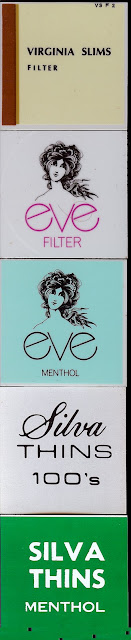
Cigarette machines had small panels displaying which brand you were selecting.  Some are displayed here - my own collection from 1971.  New cigarettes were coming out like Virginia Slims (for women!), leaving unfiltered Camels for the rasty old men.  I have a feeling New Leaf cigarettes were supposed to attract a younger crowd that was slow to exhale.  How many of these brands you remember?

Occasionally there were bigger jobs like installing, collecting or replacing a machine, and I would go out in the truck with Charlie, who was perhaps 5 years older than I, and a bit of a city redneck.  He had gotten to know a number of other "distributors", trucks that passed us every week.  I don't know how he discovered this, but Charlie had a thing for hot Herr's potato chips.  In the summer, the truck that distributed Herr's products to local stores got very hot in the Philadelphia sun, so whenever we passed the driver he knew, we'd have to pull over.  He'd trade two packs of Marlboros for a hot bag of chips and dive into them before they could cool down to only 90 degrees.  He was in heaven.  It was a time when cigarettes had a different place in society than they do now, and I certainly had a unique view into the value of a pack.


© 2012 John Allison

note added Aug 19, 2012

I found an actual cigarette machine in a bar in Seaside Heights, NJ this weekend.
Today's price for a pack:  $10