Introduction

Introduction

While I was born in 1951, sometimes I feel like I was born in 1914. My father told me so many stories about growing up in Philadelphia, and occasionally even about his family, that I feel some sense of at least one person's life in those years before I was born. While my mother, of course, wanted a child, I'm not sure that my father did. I think there was a part of it all that scared him, so they waited quite a while to have me. I hope I was "a relief" to my father, and I think I worked hard to be a good son. Looking back, especially at those few older pictures I have of my father, I think the very best part of his life was the first half - back when things were simple, he had good friends, and the burdens of adulthood were not yet upon him. Looking back, I feel like the best part of my life was the first half, largely due to my parents. It was a time when life was simple, controllable, and when I was actually organized! I'm sure my father found many good things in his entire life, as do I, but I believe we had this in common - that there is nothing better than growing up in Philadelphia. So, do not find the title of my new blog in any way depressing, my friends, its just a perspective that I've found interesting to investigate.

I'll start by writing about my family. I realize we are nothing special, but as we've learned from millions of pages of memoirs written and published, there can be much to be learned from those who came before us.

As I get past some family stories, this blog may be of interest to anyone who grew up in the Delaware Valley/Philadelphia/Delaware County in the 1950's and 60's, or to anyone married/partnered to one (if you are, there is much you need to understand before the two of you can communicate!).

Please check out my book, Saturday Night at Sarah Joy's. All proceeds go to the Hurricane Sandy NJ Relief Fund. Information is available at: saturdaynightatsarahjoys.blogspot.com.

Thank you!


Wednesday, August 1, 2012

Stuffing Cigarette Machines

In the Summer of 1971, I was a college student desperate for a summer job, and accepted a full time position with the Automatic Coin Vending Machine Company in Chester, PA, outside of Philadelphia.  The position paid $2.10 and hour.  My main job was to fill cigarette machines.  The company also serviced a few cigar machines for very special clients.  This was a time when smoking was much more common and "acceptable", and one could buy a pack for 40 cents, making them dispensable by a vending machine.  Every day I would go out and fill machines, putting many cartons worth of packs into a single unit.  I was never happy when I attracted attention.  I maintained machines at a few senior citizens facilities (where, for some reason, a pack costs 50 cents).  It always felt like I was in a horror movie when I filled these.  I could hear the rattle and clanks and creaks of their crutches and walkers as they slowly approached me.  Perhaps they were just curious to see a new person, or maybe they just wanted to watch.  I didn't want to find out, so I'd work fast.  Once they circled the wagons around me, who knows what would come next.  I felt guilty knowing they were being charged more; I only hope they didn't understand.

As the new kid, I also was given the task of servicing a few cigarette machines in bars in some of the poorest areas of Chester.  I'd make a point of getting to them between 8 and 9 AM.  It was scary because I had to empty the cash out of the metal can that collected the coins as well as create a dozen stacks of cigarette packs a few feet high, inside the machine.  I would come in the front door with a hand cart, carrying cartons of a variety of cigarettes.  I'd use a special key to pop the front off, and quickly pour the cash noisily out of the can into a canvas bag.  I could normally do this before they reached me.  Yes, even at 8:30 in the morning, the bars were occupied, and most of the customers came to see me.  As I would fill the machine, as fast as I could, hands would reach in, usually taking out two or four packs.  I would gently be robbed.  The first time, I protested, trying to convince them that I would have to pay for what they stole.  They patted me on the back, assured me it would be ok, and returned to their bar stools.  On later visits I understood that they weren't there to rob or hurt me, they were just poor and wanted some cigarettes.  I was later told it was the cost of doing business there. 

I don't know what cigarettes sell for now, but I'm sure that, if there were still vending machines around for them, you'd make your purchase using a credit card.  The disappearance of cigarette machines probably was more due to the need to stop selling to minors then the problems of handling money, although the price has gone up faster than that of gasoline over these years.

Cigarette machines had small panels displaying which brand you were selecting.  Some are displayed here - my own collection from 1971.  New cigarettes were coming out like Virginia Slims (for women!), leaving unfiltered Camels for the rasty old men.  I have a feeling New Leaf cigarettes were supposed to attract a younger crowd that was slow to exhale.  How many of these brands you remember?

Occasionally there were bigger jobs like installing, collecting or replacing a machine, and I would go out in the truck with Charlie, who was perhaps 5 years older than I, and a bit of a city redneck.  He had gotten to know a number of other "distributors", trucks that passed us every week.  I don't know how he discovered this, but Charlie had a thing for hot Herr's potato chips.  In the summer, the truck that distributed Herr's products to local stores got very hot in the Philadelphia sun, so whenever we passed the driver he knew, we'd have to pull over.  He'd trade two packs of Marlboros for a hot bag of chips and dive into them before they could cool down to only 90 degrees.  He was in heaven.  It was a time when cigarettes had a different place in society than they do now, and I certainly had a unique view into the value of a pack.


© 2012 John Allison

note added Aug 19, 2012

I found an actual cigarette machine in a bar in Seaside Heights, NJ this weekend.
Today's price for a pack:  $10


The Bell

If you visit the city of brotherly love today, you can get close to the Liberty Bell, housed in its own building, the Liberty Bell Center.  You can also take a guided tour of the old Pennsylvania State House, now called Independence Hall.  The experience is now a controlled one, with armed guards never far away.  (Terrorists could take away our symbols of freedom at any time.)

My friends and I stood out in the pouring rain one night in 1976 and watched them move The Bell from Independence Hall to a glass pavilion.  It was moved to its current home  more than 20 years later.

But there was a time, in the 1960's when I was in high school, when we would often take a trolley from the 'burbs into town, to roam around.  The tour always included a walk down to 5th Street to see Independence Hall and Congress Hall next door.

There were no guards.  I remember going into the room where the Declaration of Independence was written and signed.  I stood there, in the Assembly Room, looking at a set of tables, all with long green table cloths on them and a few chairs at each one!  You could feel what that full room of people must have felt like - debating, arguing, caring.  This is where the Declaration of Independence and the Constitution were written!  It wasn't just a story, it was a real place where people did a great and brave thing.

But the best part (well, second best, next to the gift shop) was walking in the front door and seeing the Liberty Bell.  It was there.  We touched it.  We sat on the wooden base below it.  We would knock on it with a bared knuckle.  It was our symbol of liberty.  We'd practically climb on it taking pictures of each other with it.  We respected it, and wanted to know it.  It was always there for us to touch - just part of a larger story, but one that was very real.  We could not have appreciated the incredible freedom we had during those days when we ran through the halls of Independence Hall.  (I only wished we'd been brave enough to go past the velvet rope, and up the stairs, to explore the second floor!)


© 2012 John Allison

Wednesday, July 25, 2012

The Garage of the Nobodies

One summer morning, the doorbell rang, and I jumped up from my coloring book to answer it.  I was 8 years old, but it was 1959, back when no one would have thought that something so simple might possibly be dangerous for a child.  Besides, my mother was in the basement doing the wash.  The neighbor man, I think he was a neighbor man, said, "The dog is getting out from under the gate." 
My natural response to the one-sentenced stranger was to let him into my house.  We walked through, out the kitchen door to the back yard, and into the garage, where he looked around, opened boxes, looked under things, looked on shelves, and looked on the floor.  Fifteen minutes later he walked out our front door with parts from three broken rakes and a plan.
We were a typical family of the 1950's.  Mom stayed at home, and Dad worked at Westinghouse, which always seemed to be on strike.  They bought a row house in Southwest Philadelphia when I was born.  We were in heaven - the American Dream!  But we were nobodies.  We never had much money, but we had as much as the families around us, at a time when people could very publicly live within their means. 
We had a garage in the back yard that could be accessed from the back alley.  It was too small for an actual car, so it evolved.  Its first inhabitant was a large wooden ladder, destined to be loaned out every weekend for it's natural life.  A push mower appeared, then a weed whacker, then an older weed whacker.  One of my earliest memories is sitting on the cool cement garage floor watching him take apart the old weed whacker.  "You never know, someone may need a nut or bolt some day," he explained.  Every screw and switch went into an old peanut butter jar.  The silver metal shaft with the plastic handle on top was hung on a nail. The inventory steadily grew.  In the summer when I was little I used to sit on the glider on the front porch, still in my jammies, and watch him when he left for work in the morning.  It was a tough walk to the corner to catch the bus on trash days, and more than once, he'd return with a golf club, broken rake or hubcap that someone had put out in the trash.  He'd often come home from work with things that were going to be thrown away.  One day I watched him dragging a big can down the street with him on the way home from work.  It was a half-full can of grey paint.  You never know, someone might be able to use it some day.
Occasionally my father would think up a use of his own for something in the garage.  We had many conversation pieces, which is what we called things that my Father and I got in trouble for.  I recall one beautiful Fall Saturday when he and I parked the family car under a nice big tree, and spent the day painting it.  He had the easy part - he used the roller, I had to trim around the edges, and I was not yet very handy with a brush.  We hoped that Mom wouldn't comment on the texture, but would have been pleased that you couldn't see the masking tape we put over the rusting fender.  It was an improvement!  And it was now the only gray car on the street.  She'd have to like that!  But we were wrong, so the car became a "conversation piece". 
Now we're not talking Sanford and Sons here, but the garage grew to house a large stock of metal, pieces of lamps, furniture, tools, wood, and of course jars and coffee cans of nuts and bolts and buttons and hooks.  While it was a place for him to go, the attraction was the sharing.  It was important to give what he could to others - it was what made the street a neighborhood - it was what people did for people.  I think he was a happy person because he had neighbors.  He was a nobody, but when he was in the garage looking for some used 2x4's for Mrs. Taylor, he was, for just a second, somebody, and someone good.  He knew what family meant, and for him, everyone was family. 
The reputation of the garage grew.
It had become not just a junk house, but junk church, and a busy one on weekends.  The priest was there to listen to your problems.  You had someone to talk to, someone who wanted to help.  It was what he did, and I was apparently second in command.  (It had to be me; my mother would never set foot in the garage for fear of being captured and disassembled by it - fingers in one jar, toes in another!)
He could come up with a fix for just about anything, usually a stretch of the imagination, but a noble try.  Someone would have a toilet problem and leave with a weed whacker part.  They could be having a problem snoring - weed whacker part.  Pet problem?  They'd leave with a brick and an idea.  As the neighborhood grew older, questions changed.  "What can I use to make an extra railing for the steps going to the basement?"  One day I saw a set of louvered doors leave - neither of us knew remembered how we had gotten them! 
As he got older, he got to the point where he often didn't recognize the people around him.  Every day he'd go out to the garage.  Maybe he was looking for something - something that he could use to fix himself.   That's what kept him busy every day until the end, patiently looking for a thing and an idea that would make it all better.
If you ever find yourself driving around Philadelphia, and you have a good eye, you might find this street.  Probably the people who live there now can't even tell you why their downspout is held together with copper wire and a golf club, or where the Christmas wreath made from a hubcap in their basement came from, or how long the bird feeder made from a coffee can has been in their back yard.  If you find this street, you'll know.  He took care of them all with the riches he had - all lovingly kept in the garage of the nobodies.


© 2012 John Allison

The Moon is a Watchful Eye


A shaft of moonlight barely smaller than the row house itself
shone through the dusty blinds into the empty narrow back bedroom
Empty save for one large plastic bag
filled with musty furry faces and an occasional intact eye.
I think I got Andy Panda, my first, a stuffed bear, when I was born.
The crowd quickly grew.
My animal friends.
They slept in bed with me
on me, beside me, circling me
until I was in my pimply teens. 
Mother would casually 'put them away' when friends came over-
to "make room"
we both knew I was too big for them.
But I was taught to value family and friends
playmates and advisors
trained listeners.

The moon would shine onto us as I went to sleep.
She'd close the blinds to hide the moon
and I, or Andy, would open them back up
Because the moon is a watchful eye.
Permanent, reliable, constant, so pure
a whiter light does not exist
A friend as well.
            (In Sunday school they would tell us about going to heaven
            and being able to gaze on the countenance of God.
            I only understood a few words of the phrase but thought that
            God must be the moon
            You never grow tired of looking.)
Sun light would come into the window
But not moon light.  We called it the moon.
The moon is coming in the window.
An important distinction.

They both died in their 80's and it took a hot
Philadelphia summer
to empty the house. 
I did what I had to do. 
Empty is harsh as a verb.
So we were down to this.
One bag of 50-year-old animal friends. 
Their faces were familiar.
Was mine?
They hadn't aged well
about as I had
I thought of hiding them all above the ceiling
in the basement
where they'd probably be with the house for another hundred years.
I sat with them in the dark room of the dark house
All the lamps, everything, all gone.
I sat there
alone
envious that they were not.
Tomorrow was junk day.  We all knew. 
The realtor was impatient.
Each friend - Andy, Teddy, Rex, Lambie, and a dozen others
lined up on the wood floor
of that same bedroom
each in the moon.
I left that Sunday night, not being able to return
for a week
to decide.

For now, they can air-out their fur,
wonder (and wander) about the empty house
Consider that things change and you can't usually go back
To decide amongst themselves
about the realities of living forever
And to talk, as they always had
when the moon was full
Happy and safe
because the moon is a watchful eye.

© 2012 John Allison

My Weekly Reader: The Children's Newspaper

In elementary school, I always looked forward to "our newspaper".  This one is dated February 1959.  I was 7 years old.  What could be better for a young coin collector than a front page story on the new pennies!  The new pennies were very cool, don't you think?


© 2012 John Allison

Tough Crowd/Funny Girl/Bye Ma

It was a tough crowd -                                                                
old, teary-eyed, hard-of-hearing, a little wobbly,     
bobbing, weaving, shaking.                                              
(Our bodies animate us when we get old
so passer-bys can tell
we’re still alive.)
The job was a challenge.                                                 
Their memories of her,                                             
dominated by the past few years,                                                           
concerned them -                                                                                             
short phone calls, frustrated visitors -
the end of participation, the brutality of Alzheimers.

She had grown small.
She once filled a neighborhood
     walked, patrolled, was recognized
then just a street
then she only filled a single house.
Awareness shrunk to just one room,
then to dimensions no larger than her.
Then less, inside,
just a little tiny space
somewhere, we hoped, between her head and heart.
It looks to us like a reflective space, a serene place to be,
but it’s not.

It seemed like a good idea at the time
“to celebrate her life”
(a well-worn line used at funerals
that are never anything of the sort.)
So I decided that my job would be
to remind them, that
the body lying behind me,
now stopped at 86,
the woman whose teeth were still in my Jeep,
the shell of a girl with lips superglued together,
had been a funny girl.

Neither Florence nor John finished high school.
Both had smiles that were more than authentic -
something that just couldn’t be held in.
This little light of mine, I’m gonna let it shine.
Don’t hide your light under a bushel basket.
They had that light, that I learned about in Sunday School.
My parents were an oddly but surely matched set.

In the factory, he worked
and in the John he read.
He read the Philadelphia Inquirer.
He read the Evening Bulletin.
He read the candy bar wrappers -
Snickers, Almond Joys, Hershey Bars,
He read money in his pocket, writing on his pencils,
cereal boxes, scrapple wrappers, toothpaste tubes,
Look magazine, TV Guide,
the lawnmower owner’s manual.
Write it and he’d read it.
Then he’d come home.
His hand, touching the chair at the dinner table, clicked him on
like the transistor radio in his shirt pocket
it’s dial peeking out at me as he ate
and talked.

“Did you know that Chervrolet
is coming out today
with a new color?”
“Robin Roberts hit two homers
against Cleveland!”
He seemed well-informed!

Then it would begin.
“The President was in Brazil.
He met with their President, Juan Valdez.”
My father talked.                                                      
It’s what he did.
A man who never paused mid-sentence                                   
to try and remember a name or place or fact;
they were of little immediate use.
He talked to make you smile.                                                    
He worked to make you laugh
even if it took hours.

My mother and I were in training -
to learn his timing -
to learn his mission.
Opportunities to speak were few
unless you participated,
so, as mother carried in the green beans, she engaged.
“Actually these beans came from Brazil.”
(an interesting coincidence when you’re five).
He agreed, informing me
that they were picked by a good friend of his
Fat Albert Valdez.
(again, an interesting coincidence when you’re five).
And off he’d go,
or off they’d go
in extended conversations that I’ve since to learn
most other families weren’t having.
We were being tutored
a fact not understood by any of us
but when he died, our training was complete
and our mission was clear.

The crowd bubbled with continued concern
But it was an old bubble, not like coke.
More like soup.
I was obligated to report that while she was alone, confused
mostly deaf and old
in her last days,
it was OK;
she was confused but she was OK, because
she was well-trained.

A few weeks before, we were at Antonio’s Pre-Mortem Pizza Shop,
a place where she felt comfortable being at, because she remembered it.
“Why do you eat so fast?” she asked, as she always asked.
“I don’t.  Glue your teeth in before we come
and you could keep up.”
Ten seconds later:  “Are you done already?”
“Yes, you’re slow.” I said.
“You eat fast.”
“Yes, Mom, I think it’s relative.”
“Who’s a relative?  Done already?”
“Yes.  Yes.”
Then, she looked me in the eye
lowered her voice
and leaned across the jagged circle of pie crusts
that we always assembled on the pan as we ate,
to inform me that, when we leave,
in the parking lot,
she intended to beat me up.

It was a funny line.
Perfect timing.
The waitress would have been puzzled.
He would have been proud.

I reported to the tough crowd
of a night not long ago
Lawrence Welk, thankfully, signed off.
An 8-second short term memory make attempts to follow Survivor useless.
The same is true for the rest of us.
Animals make few demands, so when I visited, we’d watch the Animal Channel - monkeys on TV.

“Oooooh - monkeys!” she said.
Her eyes wide with childish excitement-
a well-rehearsed move
“Do you like monkeys?” I asked, in my straight-man mode.
“Oh yes I do!”
each word was given center-stage
“Remind you of anyone?” I asked.
“Uuuummmmm . . .
Well you used to be a little monkey!”
I sat in silence, looking away blankly
from her one ‘good ear’
my best feigned hurt face.
“Oh, I’m just kidding.
You’ll always be my baby.” She said as she put her hand on the back
of my neck.
“Thank you mom.”                   
. . .           
. . .           
. . .           
“You little monkey.”           
It was perfect - the timing of a 20 year old,
the timing of him.                                               
           
So we continued
a family having a conversation.
Small talk,
exceedingly small talk,
with a timing and topic that was part of a conversation
that was decades long,
as long as a family was permitted to remain a family.
It was a conversation not crafted to communicate
but to create in another
a continuous
inner
smile.

Perhaps others would have found it curious.
But then, she was a very funny girl.


© 2012 John Allison

Tuesday, July 24, 2012

Not S&H Green Stamps, The Other Ones


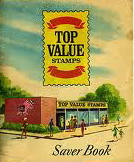
Many may be familiar with the green stamps that used to be collected, usually at the grocery store and gas station, which would be stuck into books, which were then traded for merchandise.  In Philadelphia, when I was young in the 1950's and 60's, my mother focused on Top Value Stamps, "yellow stamps", that we got from the Penn Fruit grocery store chain. 

The mechanics of the stamps were simple - the benefits amazing.  At the checkout counter you would get a stamp for every ten cents you spent.  One would take them home, and lick & stick them into a saver book, a 30 page book which held 50 stamps per page.          
                          

I'm sure many young boys and girls spent many hours dreaming about the contents of their catalog.  A catalog of free stuff!  All you needed to do is fill books of stamps, each lovingly licked and put into place, and you can go to a "redemption store" and get anything!

Now, the Sears catalog was much bigger than the Top Value Stamps "Family Gift Catalog", but the differences were substantial.  This was a book of dreams. 

My mother was always bringing home stamps, and I was always licking them for her, watching books get filled and kept in the dining room until that day when we could buy something.  I know my mother bought a toaster oven with Top Value stamps. 

I still have our catalog from 1968, and many pages are dog-eared because they contained things I wanted.  You could get a very respectable Schaefer Pen and Pencil Set for only 1 book!  You were officially an adult when you had a Schafer Pen and Pencil set!  As a growing boy, I was well aware that one could get ladies' underwear, since the catalog had the pictures (Lycra Spandex Bra, 1 book).  There were Swank cuff links for 2 1/5 books, that were actual "gold"!  Obviously for real men!

If you wanted to get serious household items, a Haviland "Fontenay" China 5 pc. Place Setting went for only 6 2/5 books.  Expecting parents could get a Wooden Crib for 12 3/5 books or a Whirlpool electric clothes dryer, full size, for 40 books.

I had my favorite set of items in the catalogue.  I could get a rifle - a Remington .22-caliber bolt action, single shot rifle for 7  1/5 books.  A rifle!  What I wanted even more, and actually got (thanks Mom) was a Harmony Classical guitar for 14 books.  Those took a while to save up for!  There were grills, and cameras, small Harleys, sofas, TV's, even mink coats!  I wanted to get a Delta 10" bandsaw  (40 4/5 books) for my father, and a 23" Magnavox Color TV (194 books) for my mother.  I spent hours staring at two pages in particular, reading the descriptions.  Which would I try to get first?  You could get a boat!  They showed a Chris Craft 30 ft Futura Boat for a whopping 2664 books, one of the most expensive things in the catalog.  While I loved boats, I would have been perfectly happy with, are you ready for this?  They listed three cars in the catalog I had.  You could get a 1968 Ford Mustaang Fastback for only 926 books!  It was like a free car!  You have to love a country where you get cars because you bought food at the supermarket!


© 2012 John Allison


the other guys